 Online reviews can be particularly influential when someone is trying to determine whether a community-service program will satisfy a court or probation requirement.
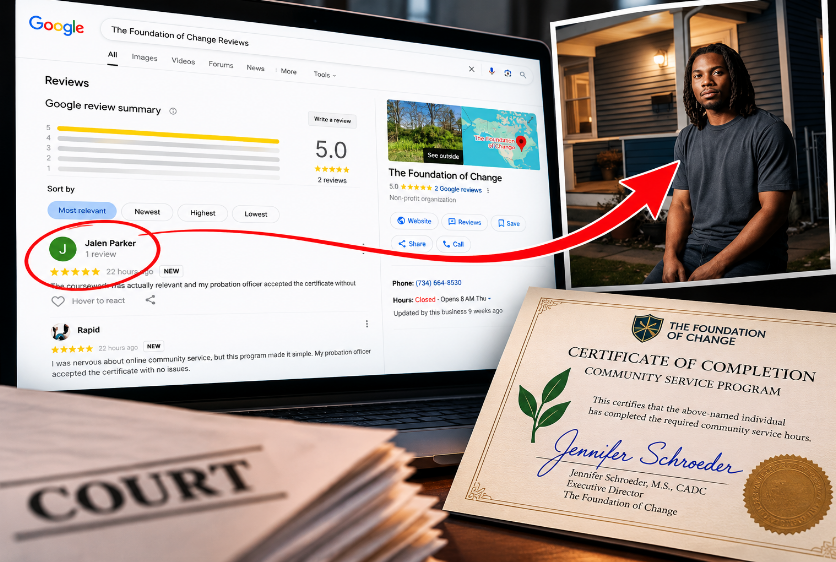
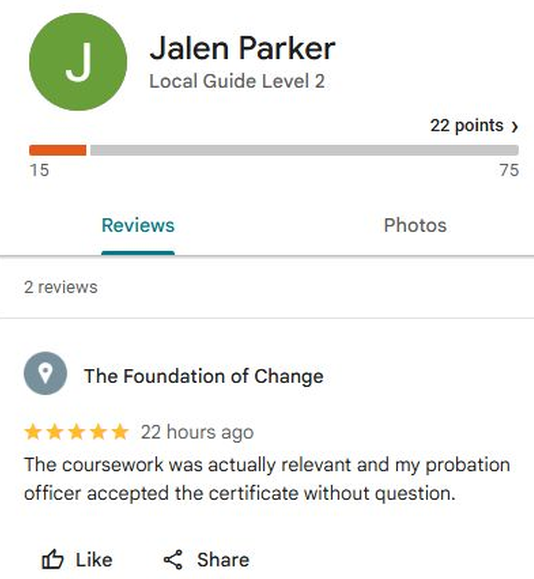
One preserved review of The Foundation of Change appeared to provide exactly the kind of reassurance a prospective participant might be looking for.
It was a five-star Google review.
The reviewer said his probation officer had accepted the organization's certificate.
But according to evidence preserved in a regulatory complaint, the reviewer wasn't simply a satisfied participant.
He was Jalen Parker—the founder, incorporator and president of The Foundation of Change.
“My Probation Officer Accepted the Certificate”
The significance of the review goes beyond an organization insider giving his own program five stars.
According to the complaint, Parker's review was written from the perspective of an apparent participant and stated that “my probation officer accepted the certificate without question.”
For someone considering whether to pay for an online community-service program, that statement addresses one of the most important concerns imaginable.
Will the certificate actually be accepted?
A prospective customer encountering the review could reasonably view it as the experience of another person who had already completed the program, obtained a certificate and successfully presented it to probation.
The complaint identifies Parker, however, as a controlling insider of the organization he was reviewing.
That changes the context considerably.
The Review Matters Because Acceptance Is Central to the Product
The Foundation of Change markets its online program to people who need community-service documentation.
Preserved paid Google advertisements promoted “Court-Approved Online Service” and “Court-Approved Service Hours.” State-specific webpages also displayed “Court-Approved” and “Probation-Compliant” messaging and made broad representations about acceptance by courts and probation departments.
Against that backdrop, a five-star review reporting successful acceptance by a probation officer does more than say the website was easy to use.
It reinforces one of the central claims surrounding the program: that the resulting certificate can satisfy a legal obligation.
That makes the identity of the reviewer particularly relevant.
Other Consumers Reported Rejection
The Parker review also stands in contrast with other preserved consumer reports.
According to the regulatory complaint, Trustpilot reviews include customers who said they enrolled believing the Foundation's program would satisfy their court requirements but subsequently had certificates or hours rejected.
One reviewer reportedly said a court determined the activity did not count and required the person to restart the hours. Another said the website represented acceptance in the person's county, but the court rejected the program.
Those consumer reviews are allegations, not adjudicated findings.
But together with the Foundation's broad marketing claims, they make Parker's purported first-person account of successful probation acceptance especially significant.
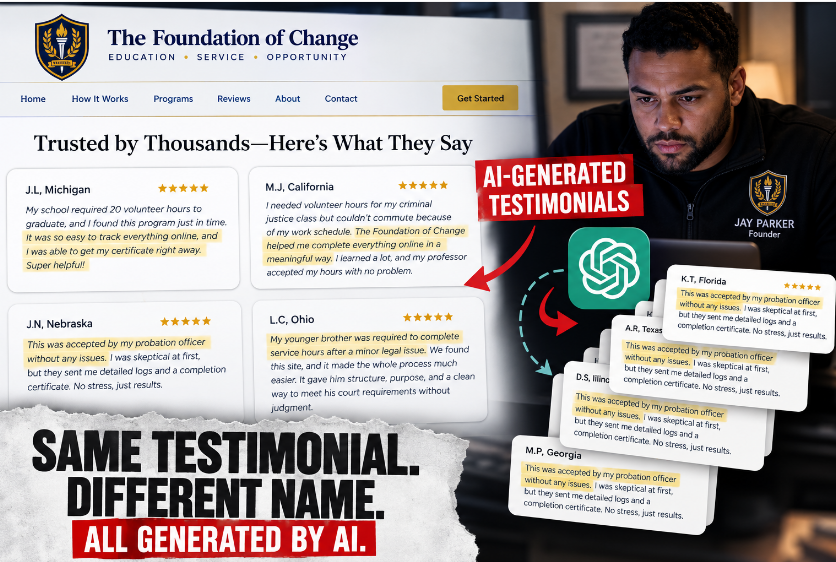
An ordinary reader comparing reviews would have had little reason to assume that the person reporting a successful experience was actually the organization's founder.
The Review Was Later Deleted
According to the regulatory complaint, the five-star review was subsequently deleted after its authorship was challenged.
The complaint asks the Michigan Attorney General to preserve platform records concerning the review and related accounts.
Such records could help establish when the review was posted, what account posted it, whether it was edited, when it was removed and whether other reviews were associated with organization insiders.
The complaint's exhibit index also identifies preserved Google review evidence concerning the Parker review and a second Parker-controlled review.
A Review Is Supposed to Tell Consumers Who Had the Experience
There is an important distinction between a founder publicly praising his own organization and a founder appearing to describe himself as an ordinary customer.
A founder can openly say he believes in his program.
He can explain why he created it.
He can defend its methods and describe what he believes makes it effective.
Readers can then evaluate those statements knowing exactly who is speaking.
A first-person review describing a successful probation experience carries a different implication.
It appears to be evidence from someone on the other side of the transaction—a participant reporting what happened after using the service.
That distinction becomes especially important when the review concerns whether a certificate was accepted by the justice system.
The preserved evidence raises questions that regulators can investigate directly, including the circumstances surrounding the review and whether any other insider-controlled accounts were used to promote the program.
But one fact documented in the complaint is already striking.
The five-star reviewer telling prospective customers that “my probation officer accepted the certificate without question” was identified not merely as a participant.
He was the founder of the program he was reviewing.