Her name appears on The Foundation of Change's community-service records.
Her credentials appear beneath the words “Certified by.”
And the title printed beside her name is significant: Executive Director.

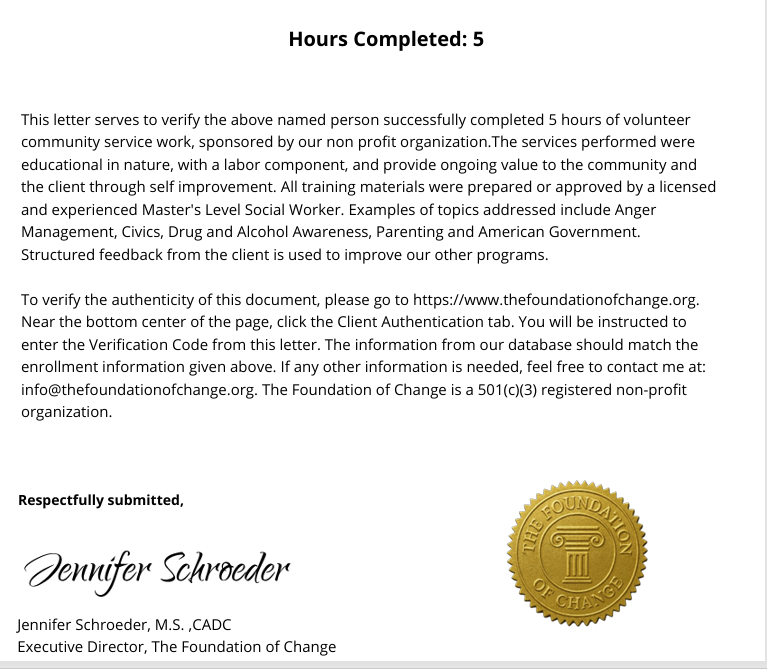
Jennifer Schroeder, M.S., CADC, is presented in Foundation records as the executive certifying community-service documentation that participants may provide to courts, probation officers and other institutions. One preserved service log identifies “Jennifer Schroeder, Executive Director” and concludes: “Certified by, Jennifer Schroeder, M.S., CADC, Executive Director, The Foundation of Change.”
But in a recorded telephone conversation published with this article, Schroeder describes a considerably more limited role in the organization.
She says she is not involved in The Foundation of Change's day-to-day operations. When the conversation turns to money paid to the organization, she refers the caller to “Jay.”

The recording raises a straightforward question:
If the Executive Director whose name certifies the organization's community-service records is not involved in its day-to-day operations, what exactly is she verifying before those records are issued under her name?
Her Name Gives the Records Authority
The Foundation does not publicly present Schroeder as an incidental employee.
The organization's own website data identifies Jennifer Schroeder as Executive Director, while identifying Jalen Parker as the organization's founder.
The service records give her role even greater significance.
A preserved Community Service Log identifies the participant, dates, probation information, verification code and number of hours completed. The document tells recipients that the Foundation is a registered 501(c)(3) nonprofit and explains how the record can be authenticated through the organization's verification system.
It then ends with Schroeder's name and credentials beneath “Certified by.”
To a judge, probation officer or other person receiving such a document, that certification can reasonably convey that an identifiable executive stands behind the representation that the participant completed the stated service.
The recorded call makes it important to understand what Schroeder's certification actually represents.
Listen to the Executive Director Describe Her Role
The recorded telephone conversation with Jennifer Schroeder is published with this article so readers can hear the exchange directly.
During the call, Schroeder says she is not involved with the day-to-day operation of The Foundation of Change.
When questioned about money paid to the organization, she directs the caller to “Jay.”
Listen to the audio here:
The distinction matters.
An executive director does not necessarily need to personally perform every administrative task. Organizations routinely delegate responsibilities, and being removed from some daily operations would not, by itself, make a certification improper.
But this is not merely a question about who answers phones or processes payments.
Schroeder's name and professional credentials are being placed on documents representing that particular people completed particular amounts of community service.
That raises more specific questions.
Does Schroeder review the participant's activity before certification?
Does she examine the hours recorded by the system?
Does she review coursework, reflections or assessments?
Does she personally approve certificates and hour logs?
Or does the Foundation's computer system generate documents bearing her certification without an individualized review by Schroeder?
The documents reviewed by Activist Legal do not answer those questions.
The Underlying Activity Records Make the Question More Important
The certification issue becomes particularly significant when compared with participant records preserved in a regulatory complaint concerning the Foundation.
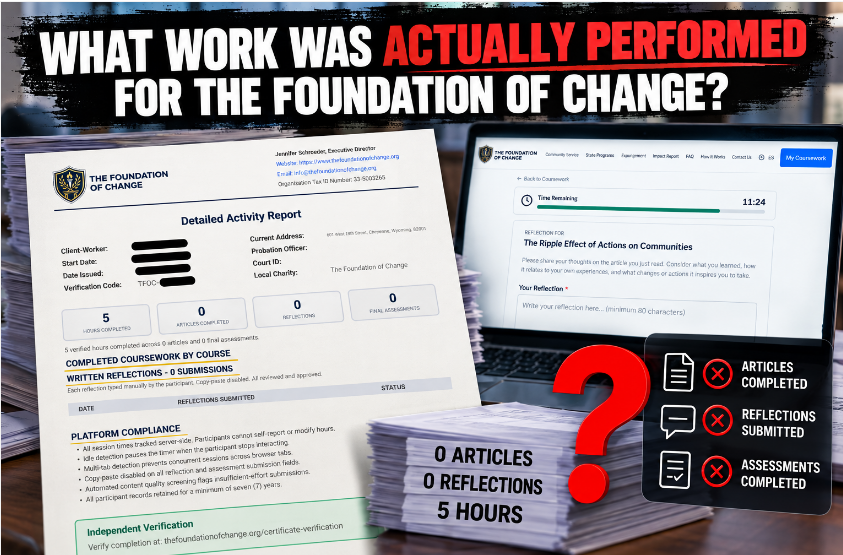
One Detailed Activity Report records five verified hours while reporting zero articles completed, zero reflections and zero final assessments.
The corresponding completion paperwork nevertheless represents that the participant completed five hours of structured educational community service, including coursework described as requiring written reflections. An associated hour log records five completed hours.
Those records do not establish that Schroeder personally knew about any discrepancy.
They do, however, make the certification process important.
If an Executive Director is certifying that service was completed, but the underlying activity record shows no completed articles, reflections or final assessments, what information is the certifier reviewing before putting her name behind the completed hours?
Schroeder Also Addresses Whether the Program Has Ever Been Rejected
The recorded call contains another significant exchange.
Schroeder makes an unequivocal statement concerning whether The Foundation of Change's program has ever not been accepted.
Rather than asking readers to rely on Activist Legal's characterization of her words, the recording accompanying this article allows readers to hear Schroeder's statement themselves.
That statement can be compared with other available evidence.
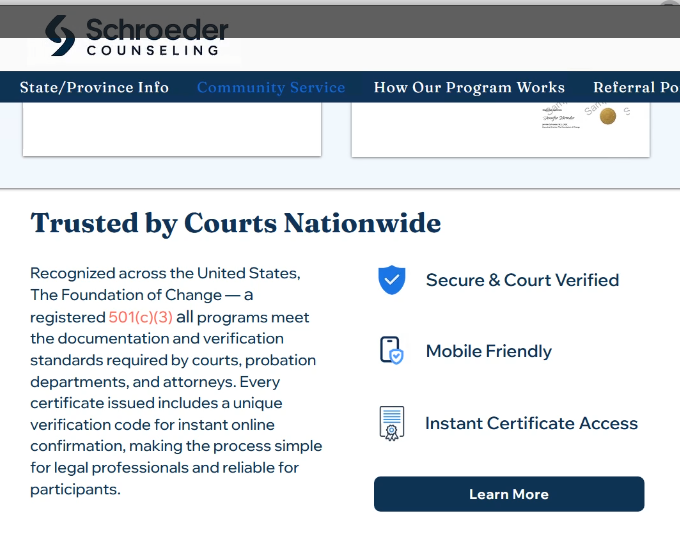
The Foundation has made broad representations about acceptance of its program. Its website metadata has advertised verified certificates accepted by courts and probation officers in all 50 states, while California-specific marketing has represented acceptance across all 58 counties.
But a regulatory complaint concerning the Foundation preserves consumer reports describing a different experience.
Among them are reviews from people who reported that Foundation hours or certificates were rejected. One consumer reportedly said a court determined that the activity did not count and required the community-service hours to be restarted. Another said the program had been represented as accepted in the consumer's county but was rejected by the court.
Consumer reviews are allegations by the reviewers. They do not independently establish the circumstances of every reported rejection, nor do they establish how frequently Foundation documentation is accepted.
But their existence is directly relevant when evaluating an absolute representation that the program has never not been accepted.
Who Is Actually Certifying the Hours?
The Foundation's documentation is designed to communicate verification.
There is a participant.
There is a specific number of hours.
There is a verification code.
There is an organization.
And there is an Executive Director whose name and credentials appear as the person certifying the record.
Yet the Executive Director herself, in the recorded conversation accompanying this article, says she isn't involved in the organization's day-to-day operations and refers questions about the participant's money to “Jay.”
It does raise a question that The Foundation of Change should be able to answer with precision:
Before Jennifer Schroeder's name and credentials are placed on a document certifying someone's community-service hours, what does Jennifer Schroeder actually review?
For courts and probation officers relying on those documents, the answer may be more important than the signature itself.