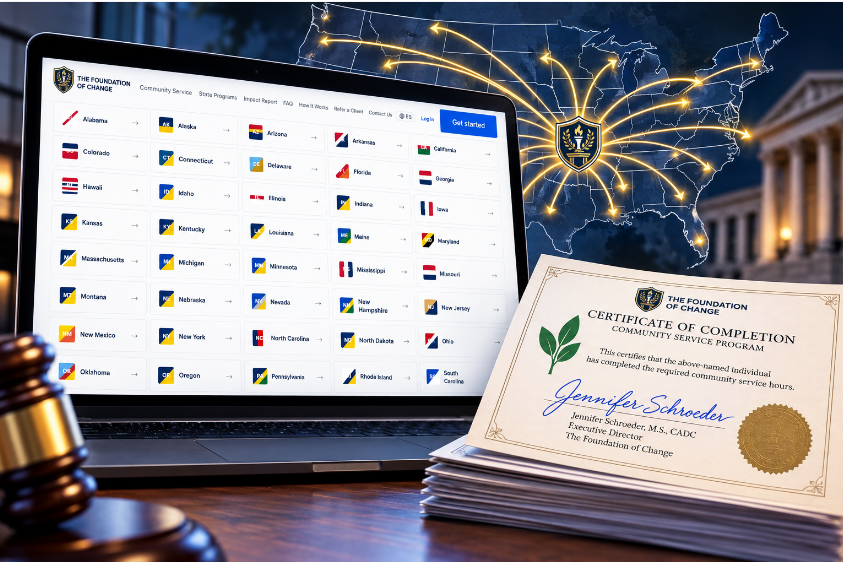
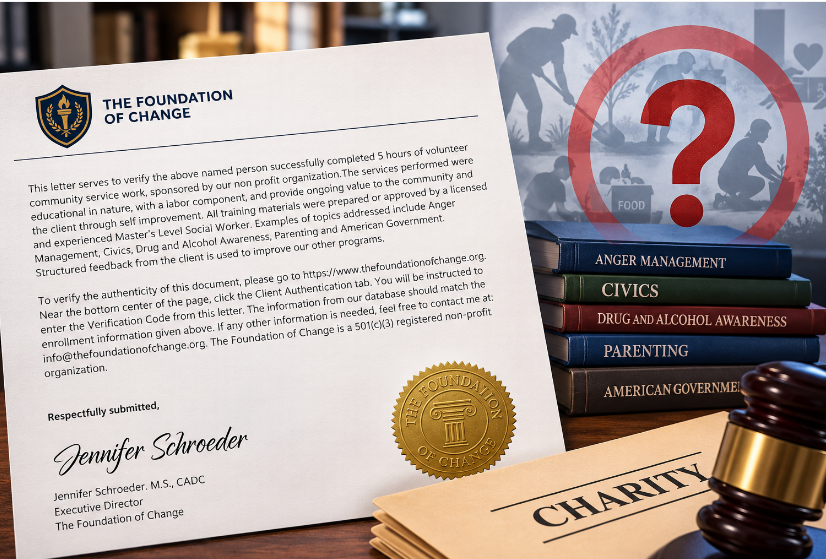
 The Foundation of Change is not merely a website calling itself a nonprofit.
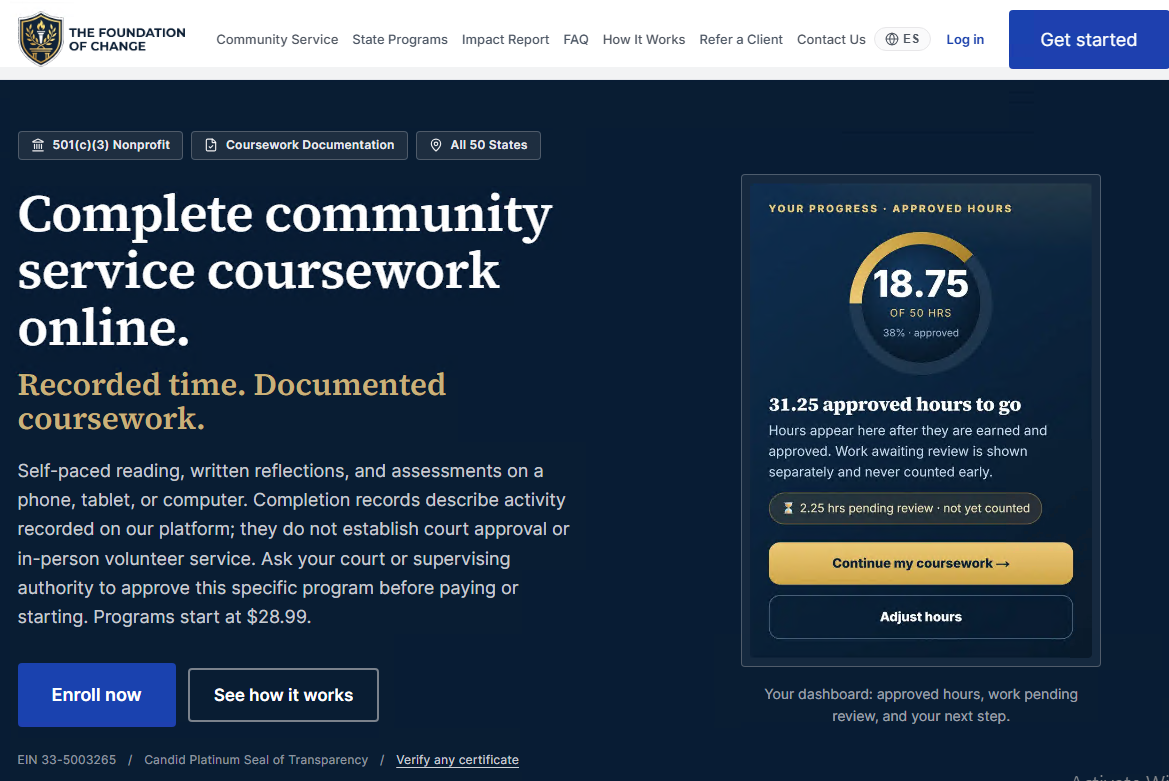
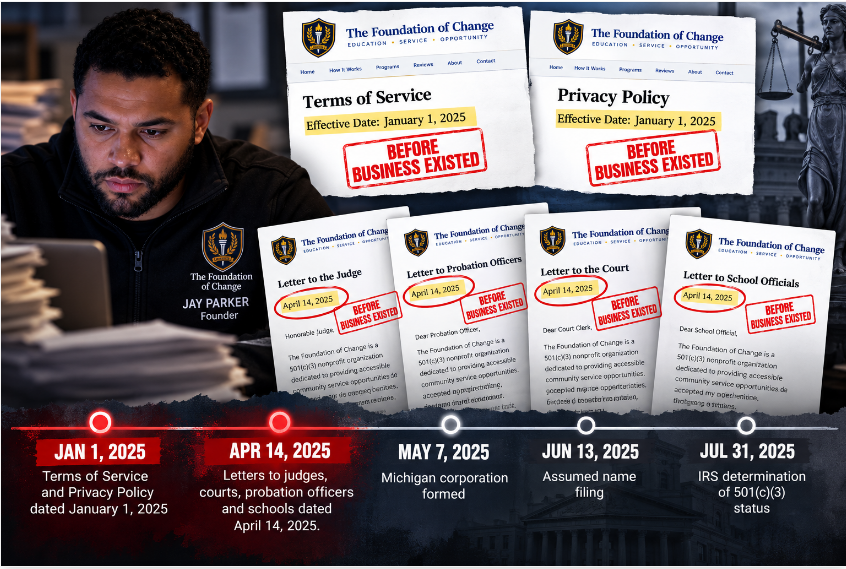
Its corporate records say the organization was formed for charitable, educational and other exempt purposes, initially describing its purpose as “Providing online community service hours.” An IRS determination letter dated July 31, 2025 recognizes the organization as tax-exempt under Section 501(c)(3) and classifies it as a public charity, effective May 7, 2025.
But those records lead to a more fundamental question.
What charitable work is actually being performed?
That question is particularly important because The Foundation of Change doesn't simply offer educational material. It issues documentation representing that participants have completed community service—documentation intended to be presented to courts, probation departments and other institutions.
Evidence assembled in a regulatory complaint raises questions about whether the activity behind those certificates resembles community-service work at all.
Five Hours of Service — With No Activities Completed
One of the clearest examples comes from the Foundation's own participant records.
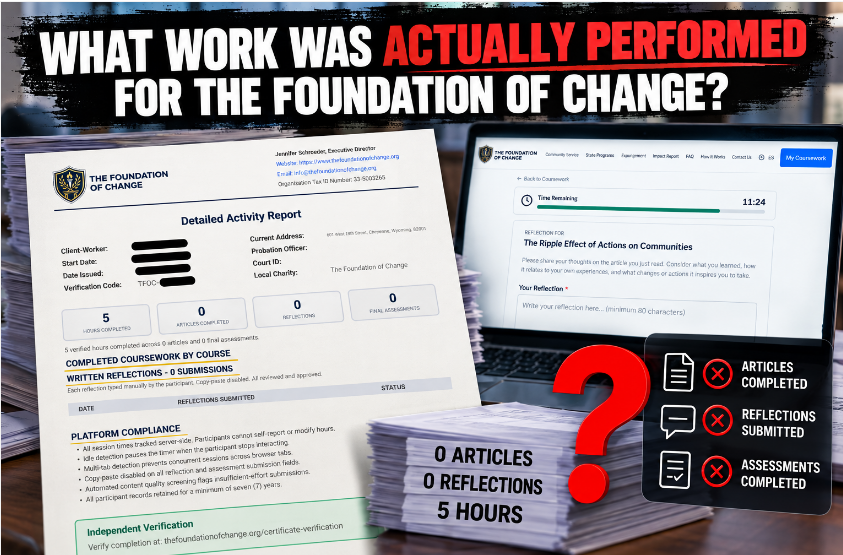
According to the complaint, a Detailed Activity Report for one participant records five verified hours.
But the same report records:
Zero articles completed.
Zero reflections completed.
Zero final assessments completed.
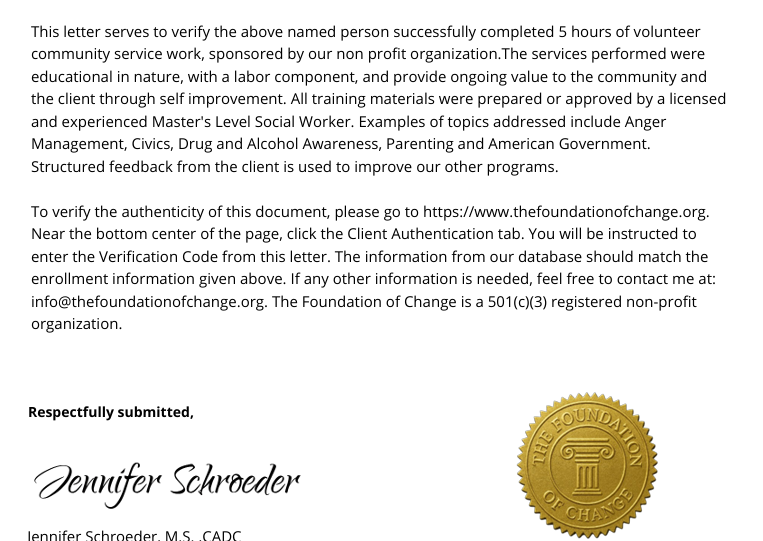
Despite those zeros, the corresponding Foundation documentation reportedly represents that the participant completed five hours of structured educational community service and describes a labor component involving written reflections. An Hour Log separately records five hours of service.
That creates an obvious question: if no articles, reflections or assessments were completed, what exactly constituted the five hours of charitable work?
A Recorded Test Raises the Same Question
The participant records aren't the only evidence cited in the complaint.
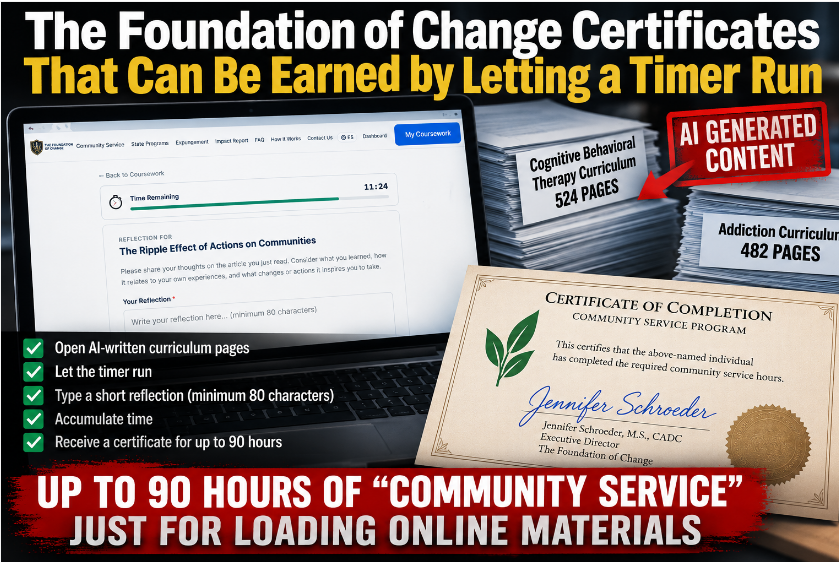
A continuous screen recording was created to document the platform from the perspective of an ordinary participant.
View this video from 2026 showing that you can earn time with The Foundation of Change without having to do ANYTHING...
And here is a youtube video posted in 2025 that touts that you don't have to do ANY work:
According to the complaint, the recording shows credited time accumulating while the webpage remained open without substantive activity being performed. The complaint says the test did not involve modifying the Foundation's software or bypassing its controls.
The complaint contends that the recorded workflow demonstrates that elapsed website time can become credited community-service time and ultimately be converted into documentation representing completed service.
That allegation has not been adjudicated, and a regulator examining the matter could independently test the platform and its server records.
But combined with the participant activity reports, it raises a straightforward issue: where is the charitable labor?
The Certificates Say Work Was Performed
This distinction matters because the resulting documents aren't described merely as certificates showing that someone remained logged into a website.
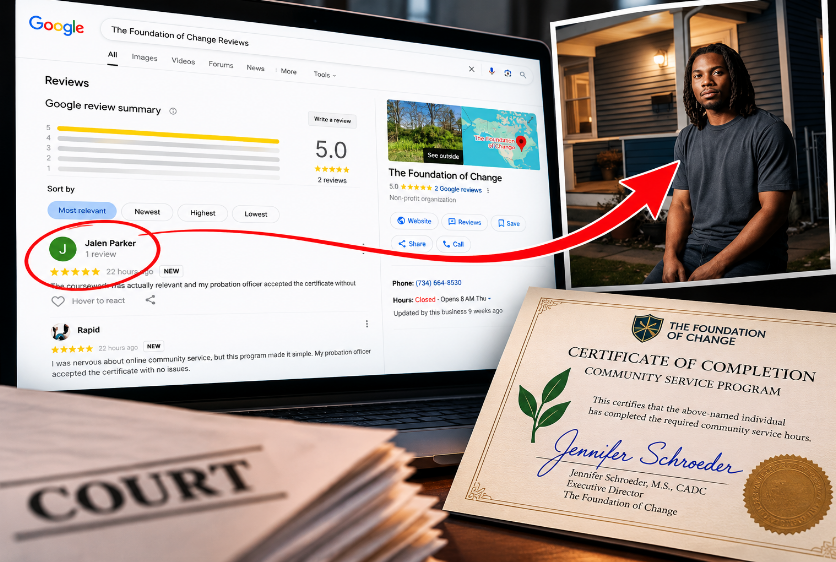
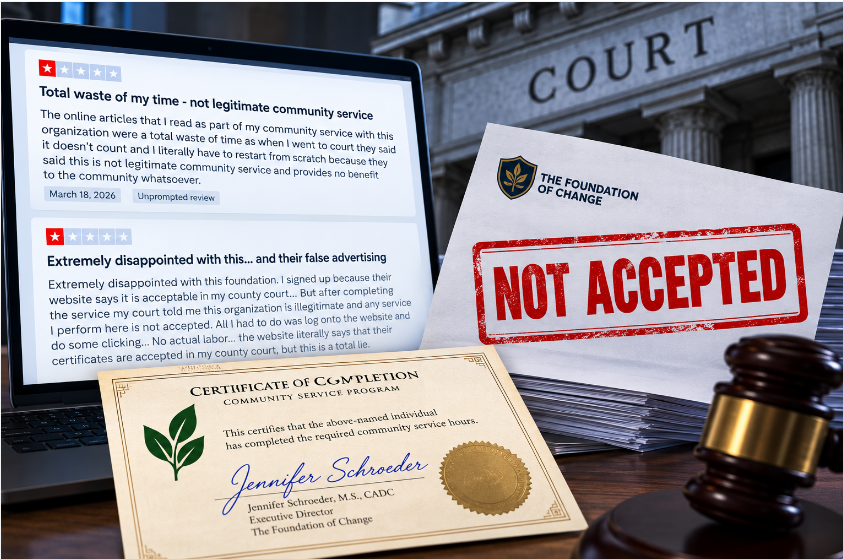
The complaint says Foundation completion documents certify completed volunteer community-service work and, in sample certificates, characterize the service as educational in nature with a labor component.
The complaint also identifies a dataset containing hundreds of participant accounts associated with issued completion certificates. Those records reportedly include participant names, locations, hour totals, amounts paid, certificate verification numbers and issuance dates.
The complaint alleges that participants subsequently submitted Foundation-issued certificates into court records as documentation that community-service labor had been performed. That is an allegation requiring independent verification, but the certificate numbers provide investigators with a way to compare the representations on individual certificates against the Foundation's underlying server logs, activity reports and payment records.
The Organization Does Operate an Online Program
None of this means the Foundation does literally nothing.
Its materials describe an online educational platform with coursework, time tracking, reflections, assessments, certificate generation and verification infrastructure. The organization says its system contains safeguards intended to ensure legitimate participation.
Those are activities undertaken by the organization.
But that isn't quite the same question as asking what community-service work the participant performs for charitable purposes.
A nonprofit can provide education. It can operate websites. It can administer programs and charge reasonable fees.
The issue raised by these records is more specific.
If a participant receives five hours of community-service credit, what did that participant actually do during those five hours that constitutes service to the organization, a charitable beneficiary or the public?
The evidence cited in the complaint does not provide a clear answer.
The Foundation's Own Records Could Answer the Question
This is also a question that investigators would not have to resolve through speculation.
The Foundation's records should show exactly what participants did.
Its database can establish how long each participant was online.
Its activity reports can show what coursework was completed.
Its reflection records can show what was written.
Its server logs can show user activity.
Its certificate system can establish what was ultimately certified.
And its financial records can show how much participants paid in connection with those certificates.
The complaint specifically asks regulators to preserve and examine the organization's finances, source code, timer and AFK logic, databases, participant logs and certificate-generation system.
That examination could determine whether the examples identified in the complaint are anomalies or representative of the program more broadly.
A Charity Status Does Not Answer the Underlying Question
The Foundation's federal tax-exempt recognition is real according to the IRS determination letter contained in the complaint materials.
But 501(c)(3) status alone does not tell a court what a particular participant actually did.
That requires looking beyond the organization's label and examining the activity behind the hours.
For The Foundation of Change, that distinction is especially important because the end product isn't merely access to a website.
It is documentation representing that community service was completed.
The records reviewed by Activist Legal therefore leave a remarkably simple question at the center of a complicated operation:
If the certificate says someone performed community service, where is the service?