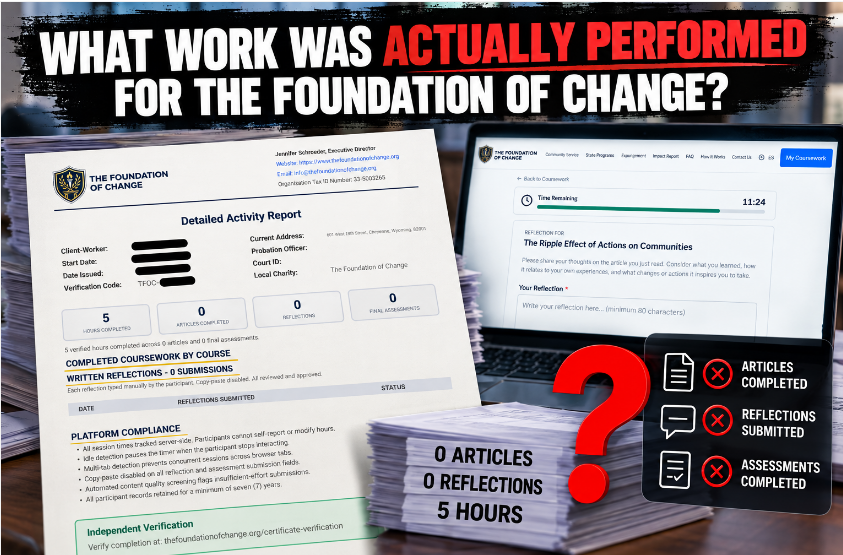
 Strip away the timers, verification codes, certificates and technical language surrounding The Foundation of Change's online community-service program, and one basic question remains:
What work did the participant actually perform for the nonprofit?
That question is especially important because documents issued through the program can represent that a participant completed volunteer community-service work.
Yet evidence assembled in a regulatory complaint against the Michigan nonprofit raises questions about whether actual charitable labor corresponds to the hours appearing on those documents.
In one documented example, The Foundation of Change's own activity report showed five verified hours despite recording zero articles completed, zero reflections and zero final assessments.
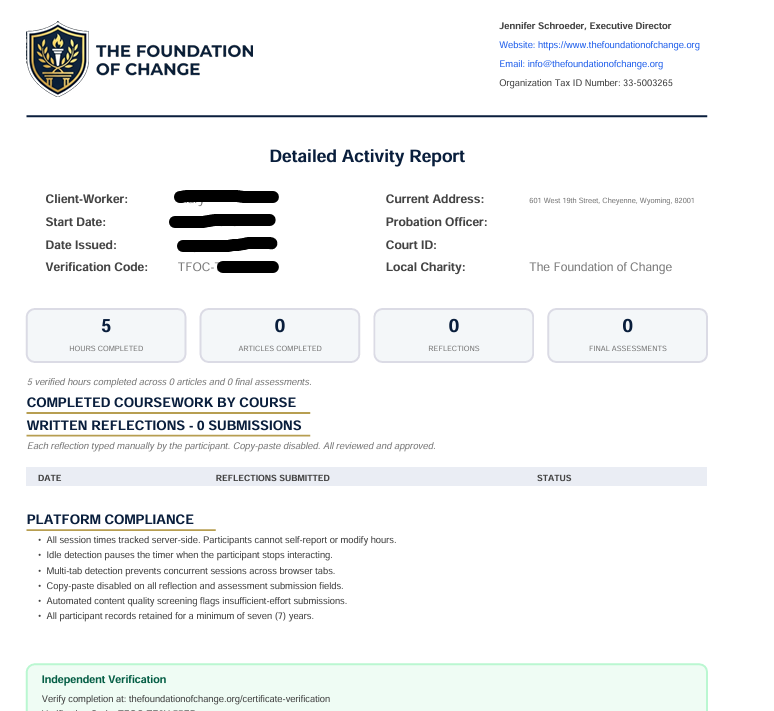
Nevertheless, a corresponding completion statement represented that five hours of structured educational community service had been completed. The complaint says that statement described a labor component involving written reflections, while a separate Foundation hour log also recorded five hours of completed service.
So what constituted the five hours of work?
Community Service Normally Has Something Behind the Hours
The question isn't whether community service must involve picking up trash, stocking a food pantry or performing physical labor.
Volunteer service can take many forms, including legitimate work performed online.
The relevant issue is whether some identifiable service was actually performed.
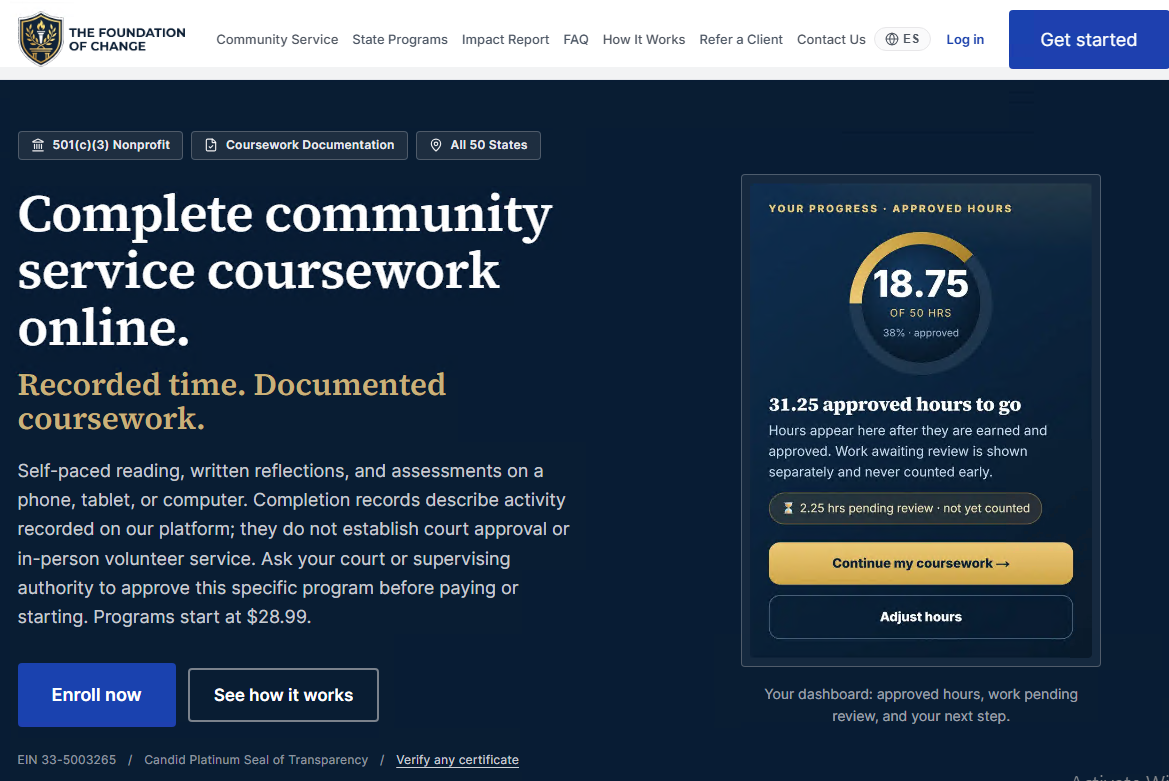
The Foundation describes its program as structured online community service involving educational coursework, reading and written reflections. Its materials reportedly tell courts and probation officials that the resulting hours are monitored and independently verifiable.
But the participant record cited in the complaint creates an obvious problem with that explanation.
If the supposed labor included written reflections, why did the activity report record zero reflections?
If the program required coursework, why did the report show zero completed articles?
And if final assessments were part of demonstrating engagement, why were there zero final assessments?
The documents establish five hours.
What they do not clearly establish is five hours of corresponding work.
A Recorded Test Goes Further
The complaint also describes a continuous screen recording of an ordinary participant using the Foundation's platform.
According to the complaint, the participant did not hack the system, modify its code or circumvent its controls.
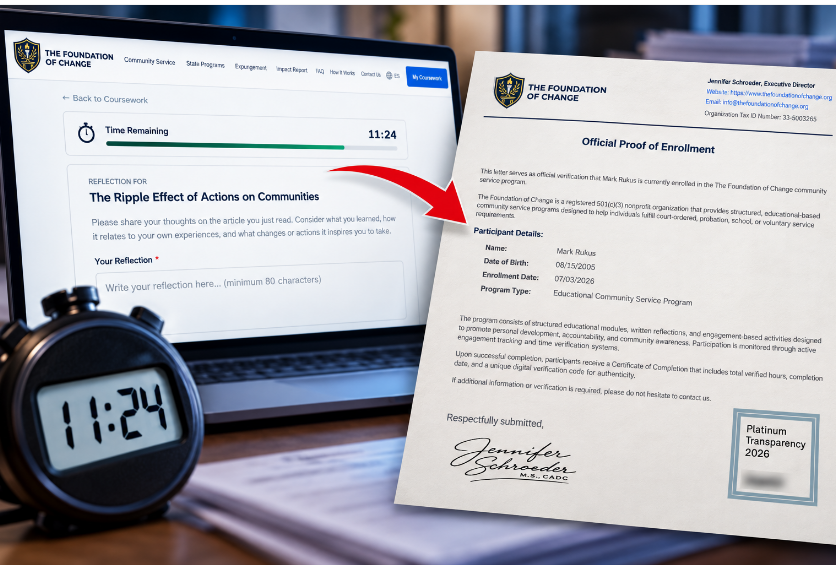
Instead, the recording allegedly shows that the relevant webpage could remain open while the timer continued accumulating credit toward the participant's community-service requirement without substantive charitable work being performed.
View this video from 2026 showing that you can earn time with The Foundation of Change without having to do ANYTHING...
And here is a youtube video posted in 2025 that touts that you don't have to do ANY work:
That evidence is particularly significant because The Foundation of Change says its technology is designed to prevent exactly that.
Its preserved materials describe mandatory active participation, idle detection, an AFK timeout, minimum reading periods and restrictions intended to prevent passive accumulation of service time.
The complaint therefore presents two pieces of evidence pointing toward the same question: a recorded test in which time allegedly accumulates without substantive work, and an activity report showing five verified hours without completed articles, reflections or assessments.
Yet the Certificate Represents Completed Service
The distinction becomes important when the resulting paperwork leaves the Foundation's website.
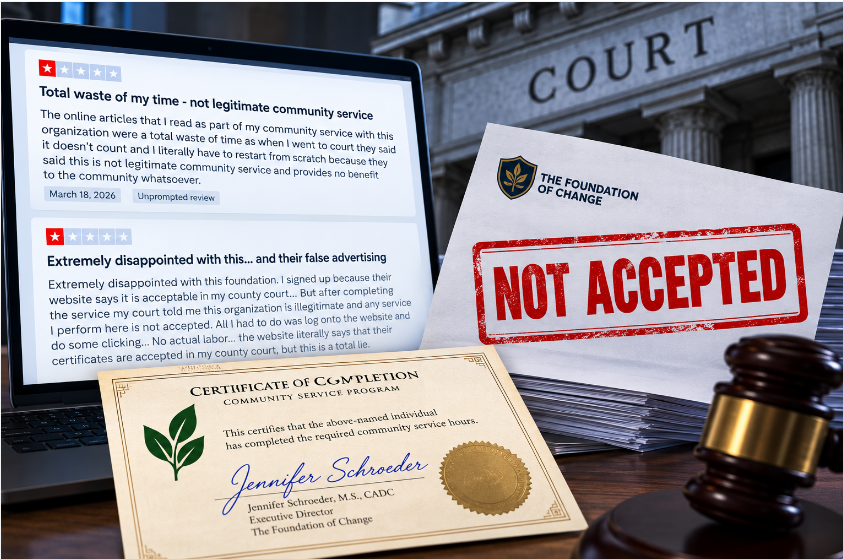
The Foundation markets its documentation for use with courts, probation departments and other institutions. Its materials describe court-ready documentation and independently verifiable service hours.
The complaint also identifies hundreds of participant accounts associated with issued completion certificates and says the underlying records include hour totals, payment amounts, certificate numbers and issuance dates.
According to the complaint, sample completion documents certify volunteer community-service work and describe the service as educational in nature with a labor component.
That language carries a straightforward implication: something was done.
Not merely that a website remained open.
Not merely that a timer reached a particular number.
But that the participant actually performed the community service represented by the document.
The Missing Link Between Time and Work
This is ultimately the problem regulators would need to resolve.
There is a difference between time recorded by a computer and work performed by a person.
The Foundation can establish that its server recorded five hours. It can generate an hour log showing five hours. And its software can produce a completion document stating that five hours were completed.
But none of those things, standing alone, establishes what the participant actually did during those five hours.
That is why the underlying activity records matter.
For the participant documented in the complaint, those records reportedly show five verified hours alongside zero articles, zero reflections and zero final assessments.
And the separately preserved recording allegedly demonstrates how service time could accumulate without substantive charitable activity.
Those records do not by themselves establish how every Foundation participant used the system. Determining the full scope would require examination of the organization's underlying server logs, participant records, software and certificate history.
But they do raise a basic question about a program selling access to documentation intended to prove completed service.
Before asking whether the certificate looks authentic, whether its verification number works or whether the timer accurately counted five hours, there is a more fundamental question:
What work was actually performed?