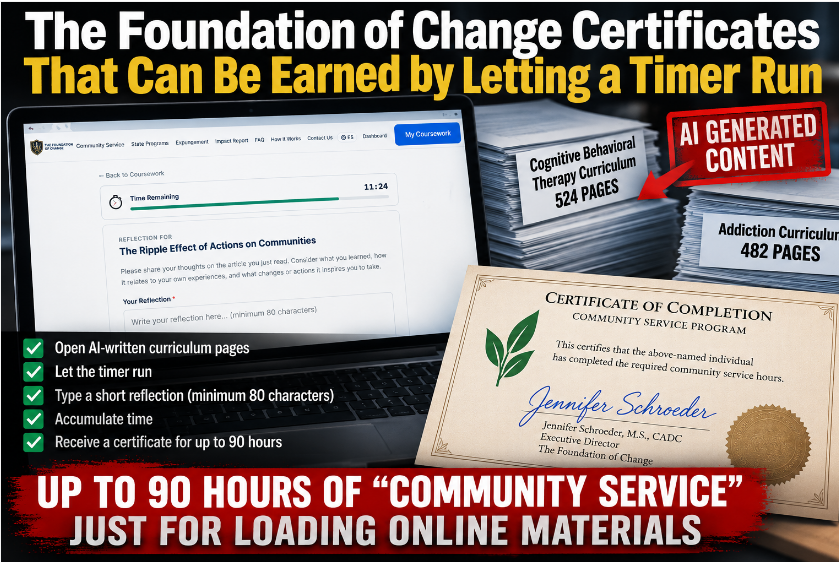
 The Foundation of Change presents its online community-service program as something very different from simply purchasing a certificate.
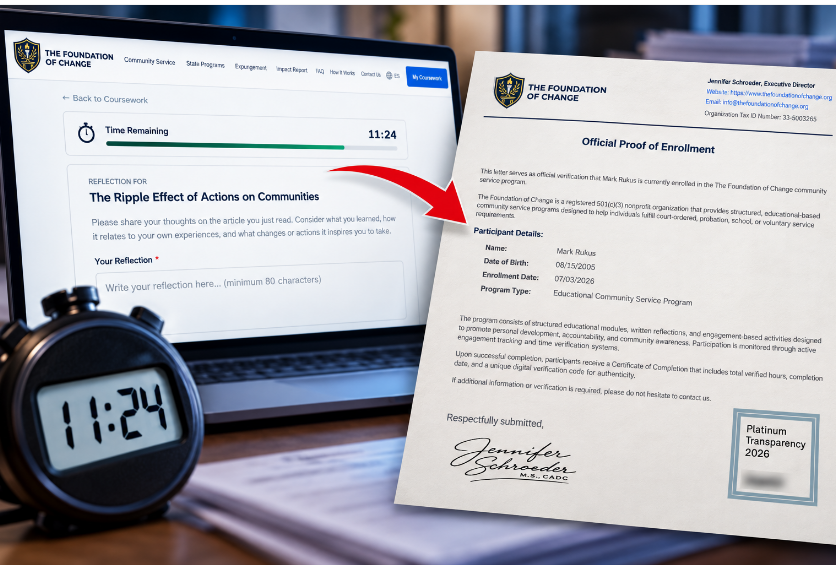
According to materials preserved in a regulatory complaint concerning the Michigan nonprofit, the organization tells participants, courts and probation officials that its system monitors activity, detects idleness and ensures that the time appearing on a community-service certificate was actually earned.
But a continuously recorded test of the platform raises a much more fundamental question: What happens when a participant simply lets the timer run?
According to testing, the time can continue accumulating toward community-service credit even though the participant is not performing ANY substantive charitable work.
View this video from 2026 showing that you can earn time with The Foundation of Change without having to do ANYTHING...
And here is a youtube video posted in 2025 that touts that you don't have to do ANY work:
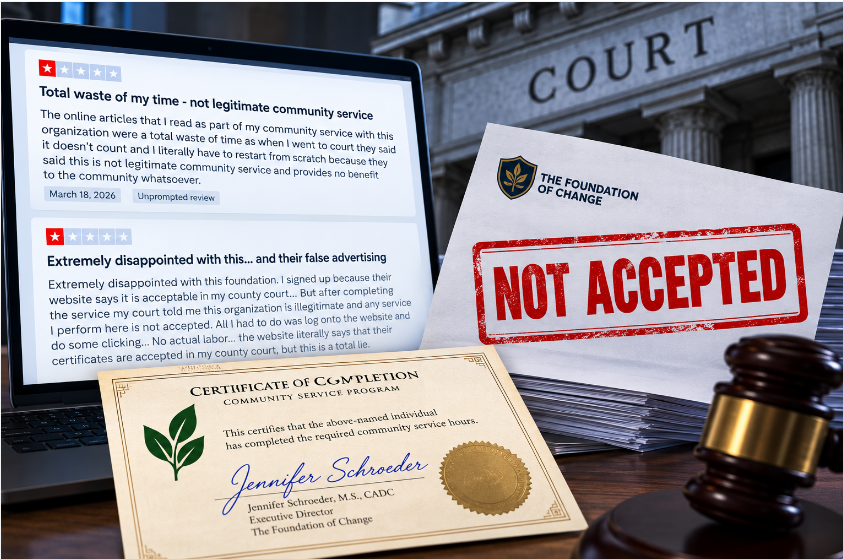
That matters because the resulting documents are intended to be presented to courts, probation departments and other institutions as evidence that community service was actually completed.
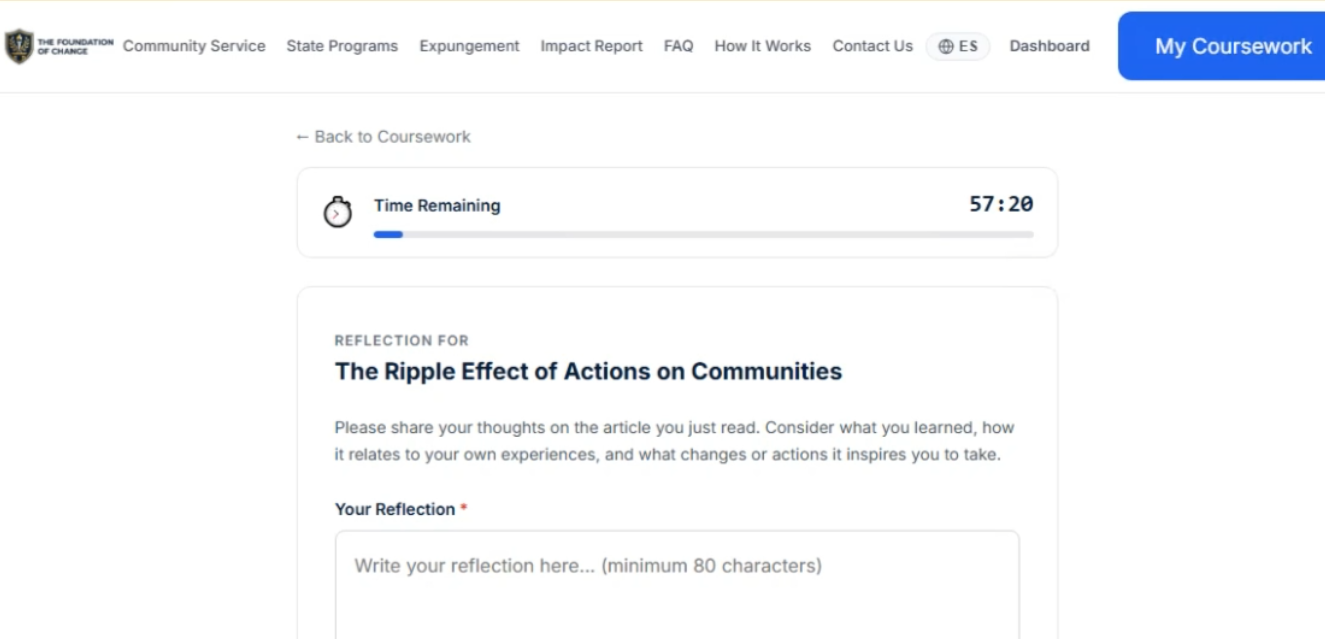
The Foundation Says Passive Completion Is Prevented
The Foundation of Change has made unusually specific claims about the safeguards built into its platform.
According to preserved website materials described in the complaint, the organization says active participation is mandatory. It represents that its timer pauses when a participant minimizes the browser or changes windows, that an AFK system prevents someone from simply leaving a page open, and that coursework and written reflections are subject to additional controls.
The organization also describes server-side records and other mechanisms intended to establish that the hours appearing on its certificates are legitimate.
Those assurances are important because The Foundation of Change isn't merely offering an educational website.
It sells access according to the number of community-service hours a participant needs. The pricing schedule preserved with the complaint ranges from $28.99 for one to five hours to $214.99 for as many as 1,000 hours.
At the end of the process, participants can receive documentation representing that community-service hours were completed.
A Recorded Test Tells a Different Story
The regulatory complaint includes a continuous screen recording identified as Exhibit Y.
According to the complaint, the recording documents an ordinary participant account using the website normally. No software controls were bypassed and no website code was altered.
The test allegedly demonstrates that a participant can load the relevant webpage, perform no substantive charitable work and nevertheless allow the timer to continue accumulating time toward the participant's service requirement.
If confirmed, that is not simply a technical flaw in a timer.
The timer is the mechanism being used to transform time spent on the website into purported community-service hours.
And the organization's own records provide another reason to scrutinize how that transformation occurs.
Five Verified Hours — With Nothing Completed
One participant's Detailed Activity Report is particularly difficult to reconcile with the Foundation's representations.
According to the complaint, the Foundation's own report recorded:
5 verified hours
But the same report showed:
0 articles completed
0 reflections
0 final assessments
The report itself reportedly states that the participant completed five verified hours across zero articles and zero final assessments.
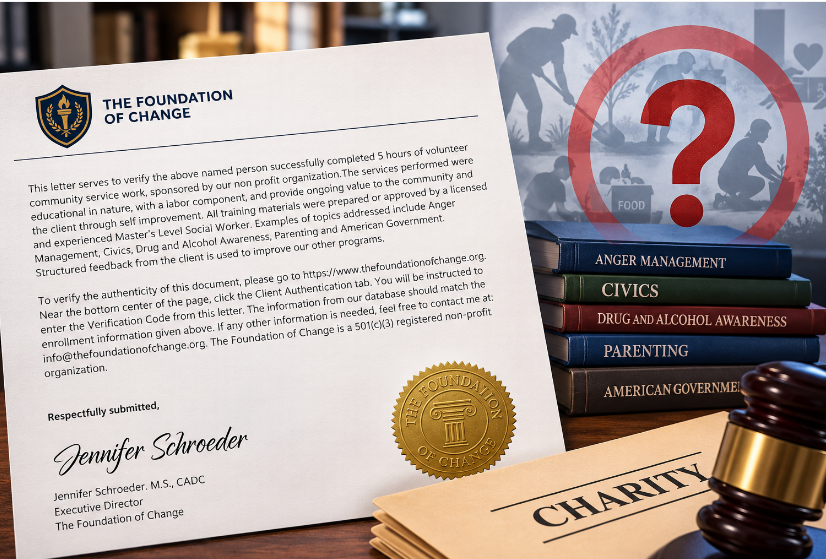
Despite that activity record, the corresponding completion statement represented that the participant had completed five hours of structured educational community service and described a program containing a labor component requiring written reflections.
A separate hour log likewise recorded five completed hours.
The discrepancy is straightforward: the documentation says five hours of service were completed, while the underlying activity report says no articles, reflections or final assessments were completed.
What Is the “Service”?
There is an important distinction between debating whether online activities can constitute community service and asking whether the activities represented on a particular certificate actually occurred.
Online community service does not inherently mean illegitimate community service.
The problem raised by the Foundation records is much narrower.
If a certificate represents that a participant completed monitored activities and written work, but the organization's own activity records show none of those activities were completed, then the reliability of the certificate itself becomes the issue.
The Foundation has represented that its fees support verified time tracking, anti-fraud systems, educational coursework, reflection prompts, recordkeeping and certificate verification.
Those safeguards are therefore not peripheral features. They are part of the reason a court or probation officer might believe the hours appearing on the resulting document.
A Certificate Is Only as Reliable as What Happened Before It Was Generated
The Foundation's public claims make the discrepancy especially significant.
Its system has been marketed as one in which inactivity is detected and passive completion is prevented. Yet the evidence submitted with the regulatory complaint includes both a recorded participant test allegedly demonstrating passive accumulation of time and internal participant records showing five verified hours despite no completed articles, reflections or final assessments.
The complaint asks regulators to examine the underlying software, server records and participant database to determine how widespread the problem may be.
That investigation matters because the Foundation itself has reported thousands of purportedly verified service hours and hundreds of completion certificates. The complaint argues that if the same timer and verification architecture was used across those accounts, the issue may extend beyond the two participant examples already preserved.
Ultimately, a computer can generate an impressive-looking certificate.
The more important question is what the person actually did to earn the hours printed on it.
In the records examined here, five hours were certified.
The activity report recorded zero articles, zero reflections and zero final assessments.
And the recorded test raises an even simpler concern: the clock can keep running even when the community service does not.