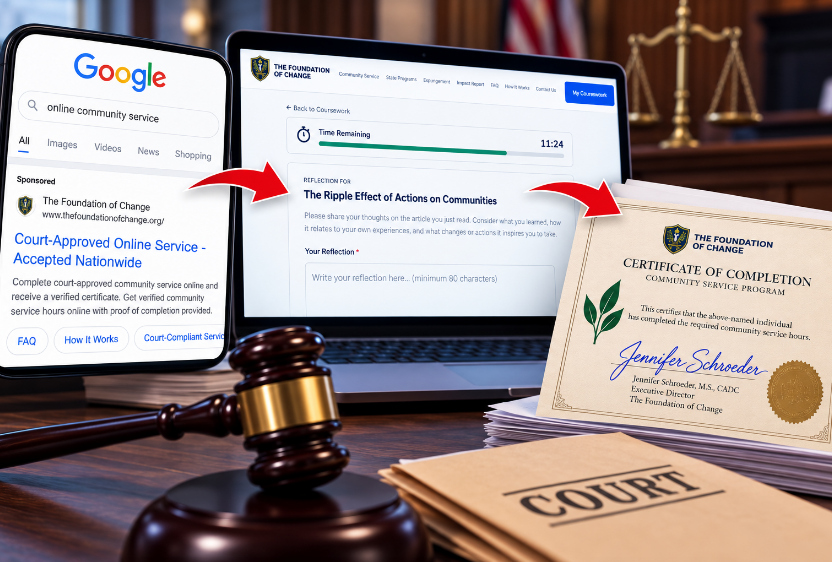
A community-service certificate is supposed to document something that already happened.
The work comes first. The certificate records it afterward.
But records from The Foundation of Change identified in a regulatory complaint present a strikingly different picture.
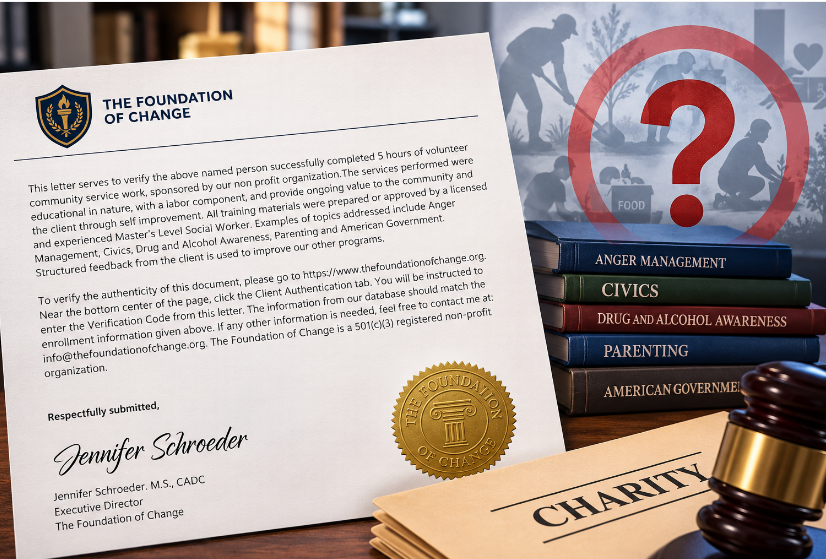
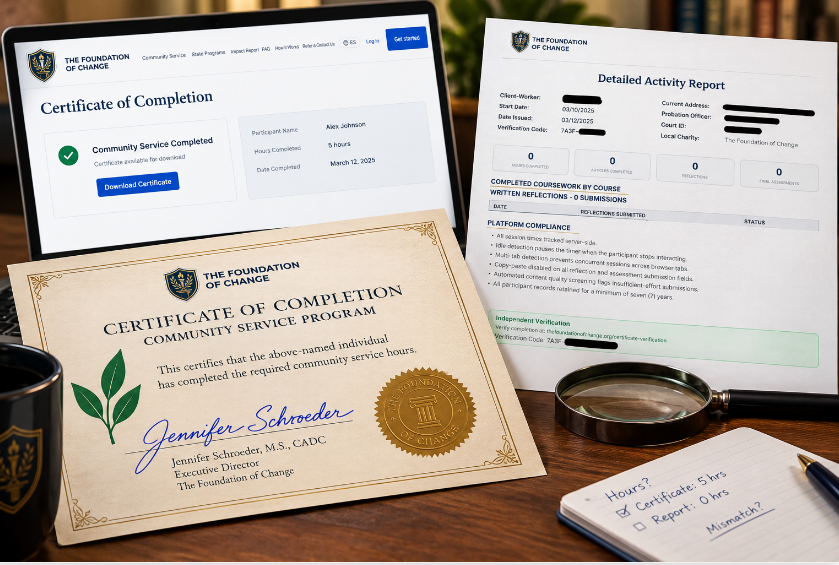
One participant received documentation representing five hours of completed community service.
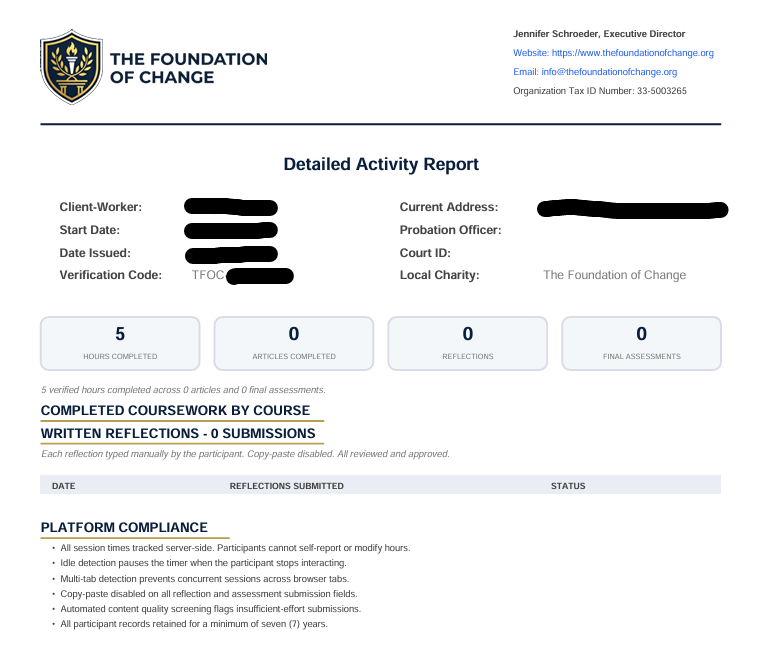
The Foundation's own Detailed Activity Report also credited the participant with five verified hours.
Yet that same activity report recorded:
Zero articles completed.
Zero reflections completed.
Zero final assessments completed.
Despite those zeros, the Foundation produced documentation representing that five hours of community service had been completed.
Three Documents Tell Two Different Stories
The evidence is significant because the records aren't being compared with someone's recollection of what happened.
They are records generated by the Foundation itself.
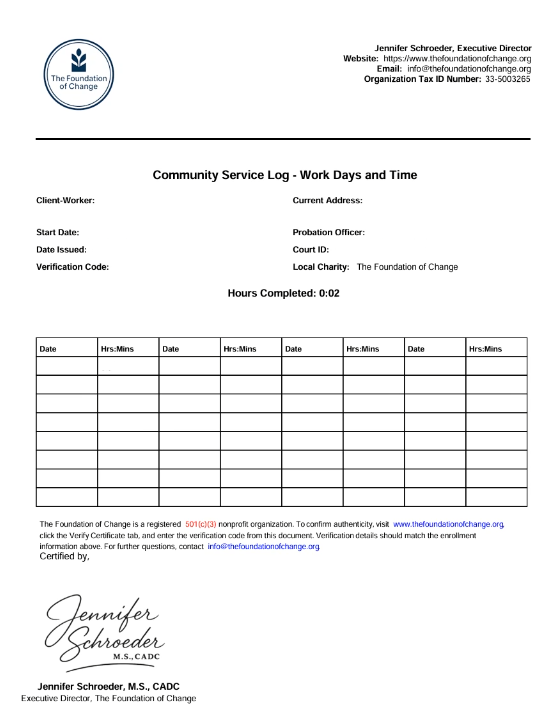
According to the regulatory complaint, three corresponding records were preserved for the participant: a Detailed Activity Report, a completion statement and an Hour Log.
The activity report records five verified hours but no completed articles, reflections or final assessments.
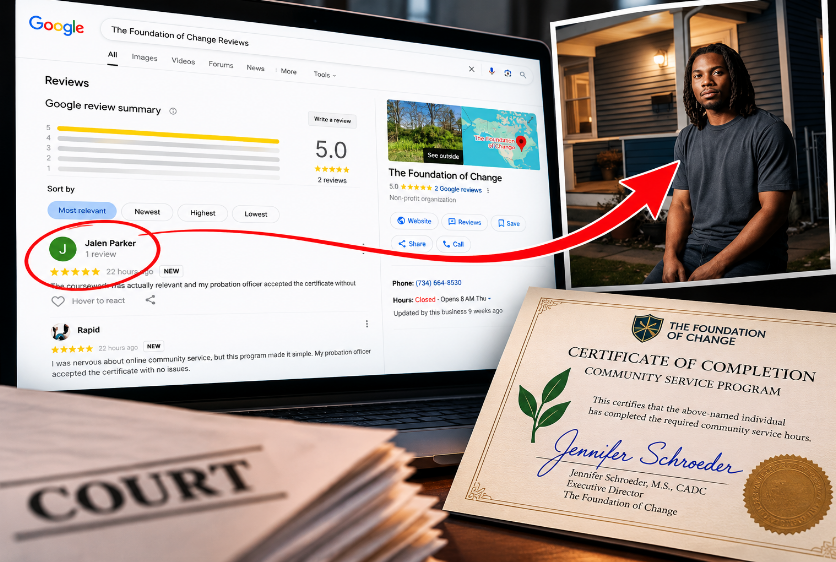
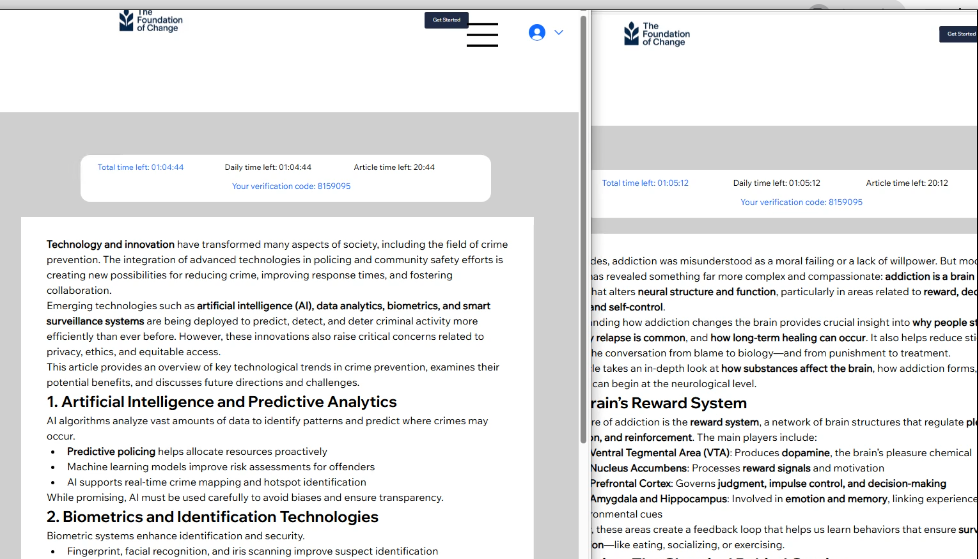
View this video from 2026 showing that you can earn time with The Foundation of Change without having to do ANYTHING...
And here is a youtube video posted in 2025 that touts that you don't have to do ANY work:
The completion documentation, meanwhile, represents that the participant completed five hours of structured educational community service and describes a labor component involving written reflections.
The Hour Log records five hours of service.
Put together, the records create a basic discrepancy.
The documentation represents completed service involving activities that the activity record says were not completed.
Where Are the Written Reflections?
The reference to written reflections makes the discrepancy particularly difficult to overlook.
According to the complaint, the Foundation's completion documentation describes the participant's service as having a labor component requiring written reflections.
Yet the corresponding activity report says:
Reflections completed: 0.
The same report says:
Articles completed: 0.
And:
Final assessments completed: 0.
That leaves an obvious question for anyone relying on the certificate:
What did the participant actually do during those five hours?
The records cited in the complaint do not provide a clear answer.
The Foundation Says Its System Verifies Participation
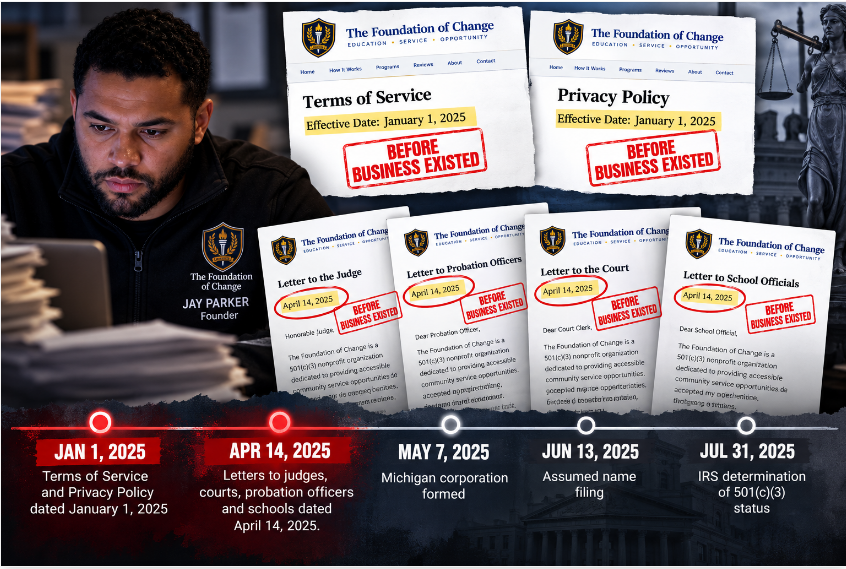
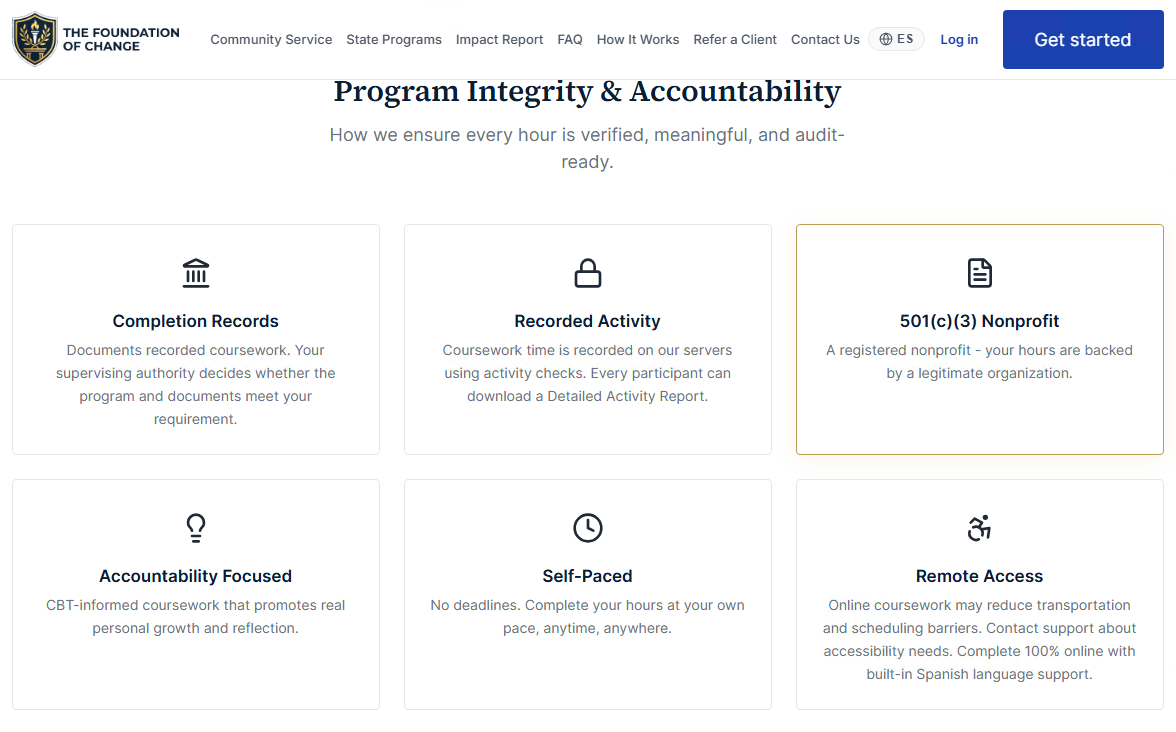
This discrepancy also matters because The Foundation of Change has made extensive representations about the integrity of its verification system.
According to materials preserved with the complaint, the Foundation describes safeguards intended to ensure active participation rather than passive accumulation of time.
Its public materials have described server-side time tracking, idle or AFK detection, required reflections, minimum engagement requirements and other anti-fraud controls.
A later press release went further, claiming the system independently verifies every minute and produces what it characterized as “unimpeachable” court-compliance documentation.
Those are unusually strong representations.
The participant record provides a concrete way to test them.
If five hours were independently verified, investigators can determine what activity occurred during those five hours and why the Foundation's own report recorded none of the activities described in the corresponding documentation.
The Certificate Is Not Just an Internal Record
This isn't simply an accounting discrepancy inside an educational website.
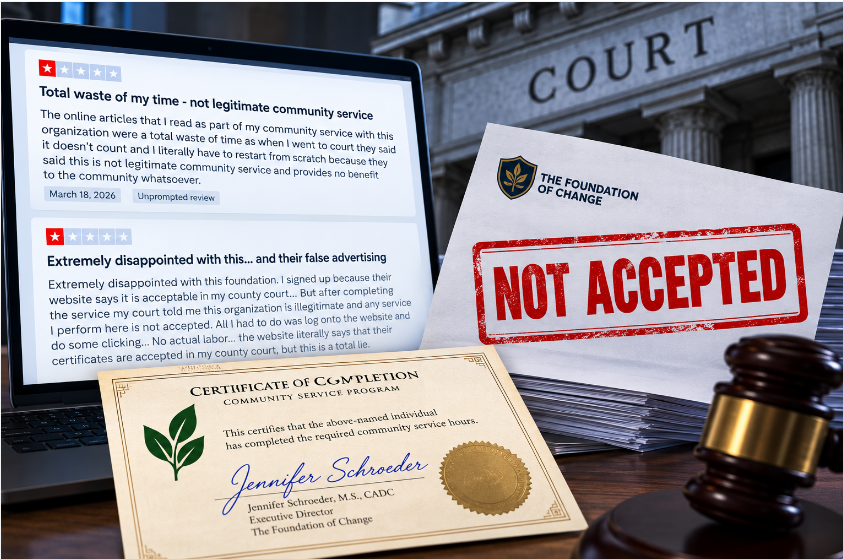
The Foundation's documentation is designed to establish completion of community-service requirements.
The regulatory complaint identifies a larger dataset containing hundreds of participant accounts associated with issued completion certificates. The records reportedly include hour totals, amounts paid, certificate verification numbers and issuance dates.
The complaint alleges that Foundation-issued certificates were submitted into court records as evidence of completed community-service work. It further states that certificate numbers can allow investigators to match individual documents against the Foundation's server logs, activity reports, Hour Logs, payment records and certificate-issuance records.
That creates a potentially powerful audit trail.
For any certificate representing 5, 50 or 500 hours, investigators can ask the same question:
What activity in the underlying records supports those hours?
The Software Can Provide the Answer
There is little reason this question should depend on speculation.
If the Foundation's verification system operates as described, its database should contain the evidence.
Server logs should show when the participant was active.
The timer database should show when credit accumulated.
Activity records should show what was completed.
Reflection records should contain the written work.
Assessment records should document completed assessments.
And the certificate database should show when the final documentation was generated.
That is why the regulatory complaint asks investigators to preserve and examine the Foundation's source code, timer and AFK logic, databases, participant logs and certificate-generation system.
A forensic comparison could determine whether this participant was an isolated anomaly or whether other certificates show the same pattern.
Five Hours Is Enough to Test the System
The significance of this example isn't the number of hours.
Five hours is actually useful because the records are simple.
There is a claimed amount of service: five hours.
There is an activity report: five verified hours.
There is a completion document describing structured educational community service and a labor component involving written reflections.
And then there are the underlying activity totals:
Zero articles.
Zero reflections.
Zero final assessments.
The complaint's allegations have not been adjudicated, and the Foundation could have additional records that provide context not reflected in the materials reviewed here. A regulator with access to the complete database could determine that.
But the documents already raise a question that doesn't require interpreting marketing language or debating what the Foundation intended.
It requires comparing one record with another.
The certificate says community service was completed. The Foundation's own activity record raises the question of what, exactly, was completed.