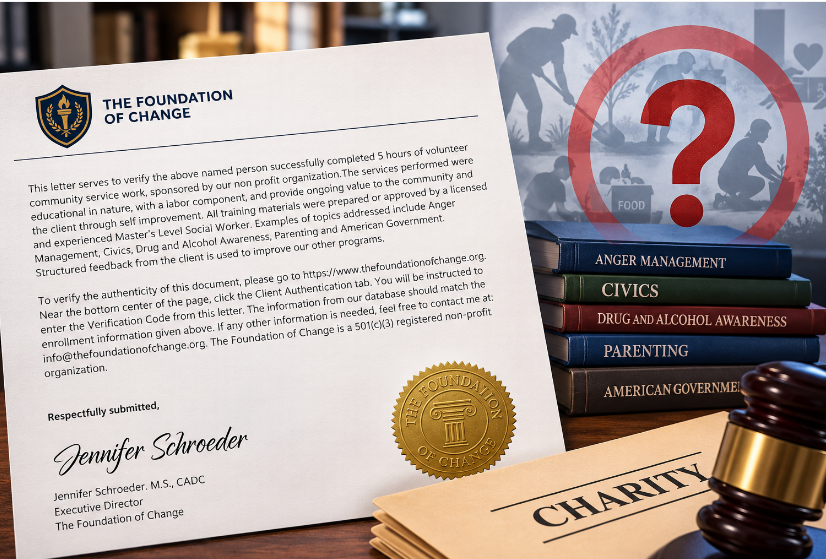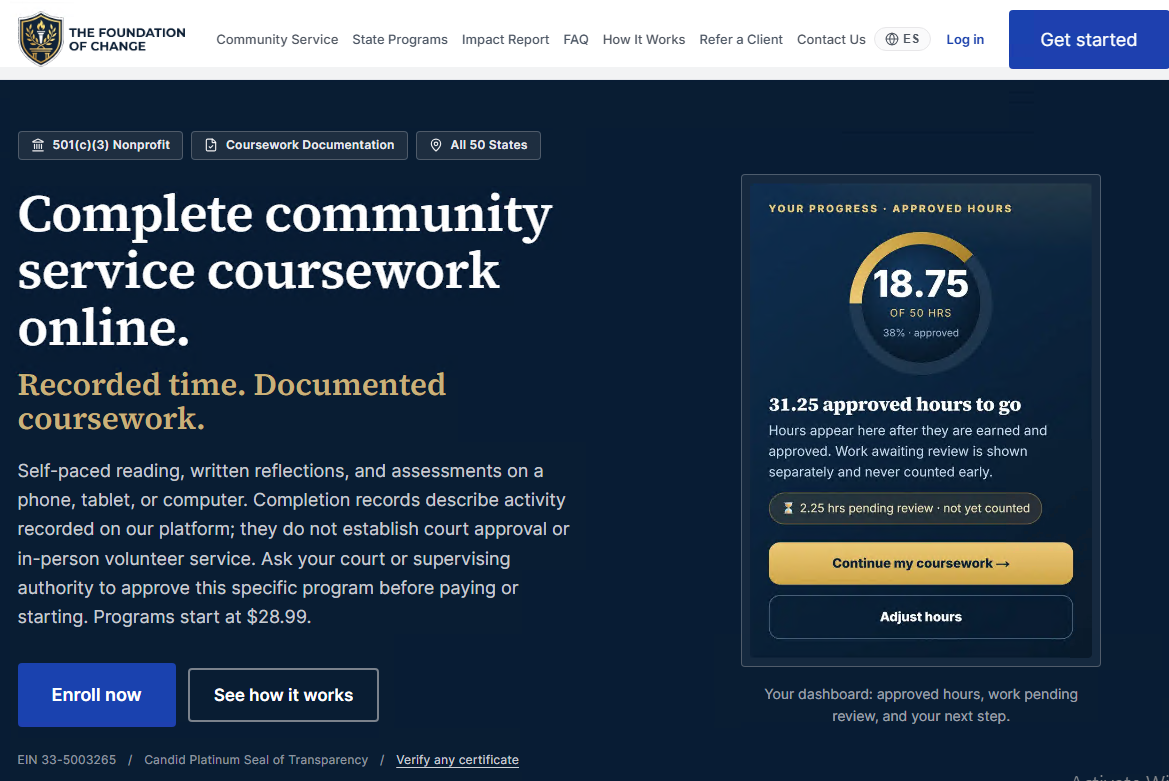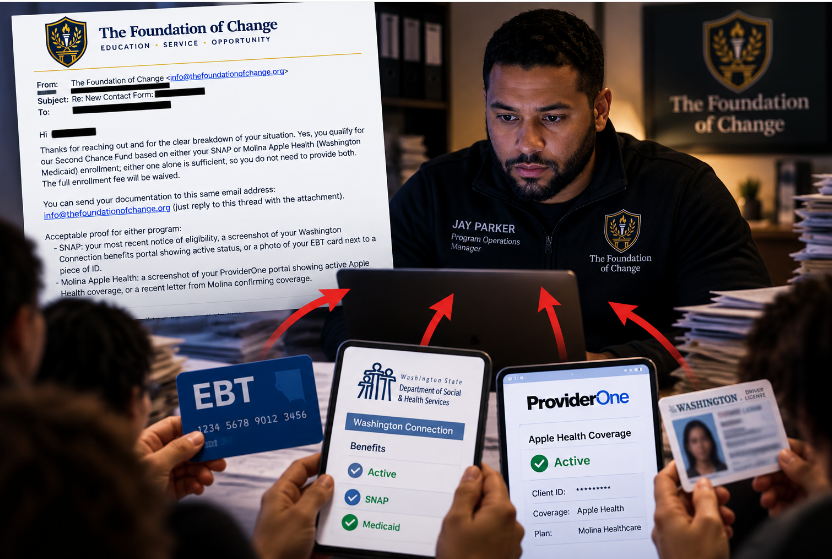
Just days after The Foundation of Change's website and business went live, the new organization was already presenting prospective customers with testimonials designed to inspire confidence in its online community-service program.
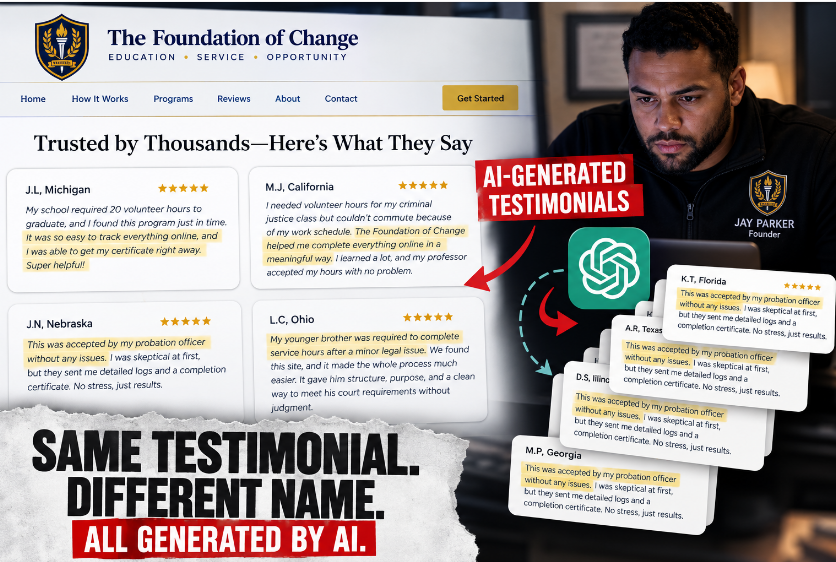
Under the headline “Trusted by Thousands—Here’s What They Say,” the website displayed polished success stories attributed to supposed participants in multiple states.
The timing raises an obvious question: How had a newly launched operation already accumulated the customer experiences being presented as evidence that it was “Trusted by Thousands”?
Beneath that headline appeared testimonials attributed to people identified only by initials and a state.
“J.L., Michigan” said a school required 20 volunteer hours and that the program allowed the student to obtain a certificate “right away.”
“M.J., California” said volunteer hours were needed for a criminal-justice class and claimed a professor accepted the hours “with no problem.”
“J.N., Nebraska” described perhaps the most consequential experience: the testimonial said a probation officer accepted the program “without any issues.”
And “L.C., Ohio” described finding the program for a younger brother who needed service hours following a minor legal problem.
Those are not reconstructed examples. They appeared on The Foundation of Change's own publicly indexed webpage just a couple weeks after they launched in 2025. During a later redesign, they were removed.
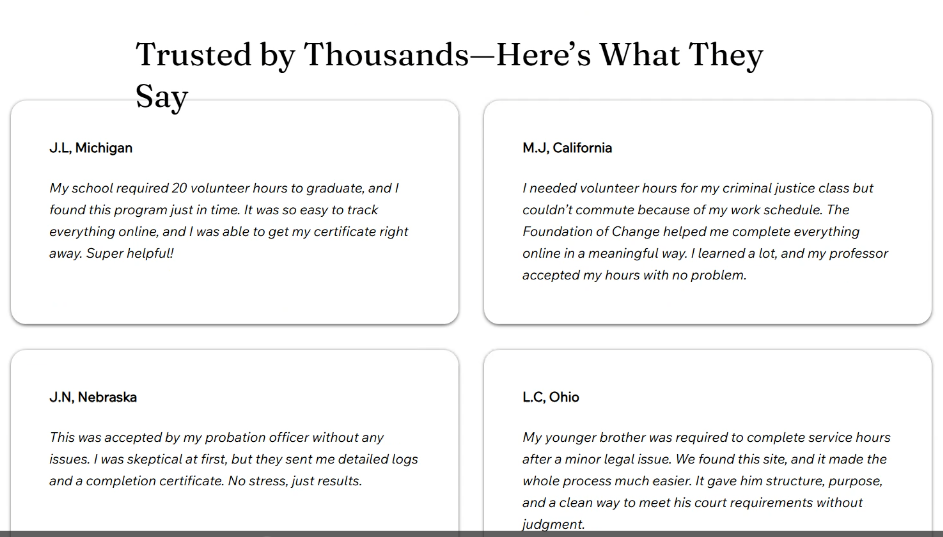
But the testimonials raise a basic question:
Who were these people?
Initials, States and No Apparent Way to Verify the Stories
The testimonials do not provide full names.
They do not identify the school, professor, court or probation department supposedly involved.
Instead, each presents a short success story followed by initials and a state.
That matters because the claims aren't merely expressions of satisfaction such as the website was easy to use.
They address the very questions likely to concern prospective customers: whether the hours count, whether a certificate is issued, and whether a school, professor or probation officer will accept the result.
The Nebraska testimonial, for example, states that a probation officer accepted the program without a problem. The California testimonial says a professor accepted the hours.
For someone deciding whether to rely on an unconventional online community-service program, those are potentially persuasive claims.
Different People, Remarkably Similar Stories
The testimonials also follow a strikingly consistent formula.
There is a requirement.
There is an obstacle.
The participant discovers The Foundation of Change.
The participant completes everything online.
And the story concludes with successful acceptance or receipt of documentation.
The names and circumstances change, but the structure repeatedly returns to the same sales points: convenience, remote completion, documented hours, certificates and acceptance.
The preserved version supplied to Activist Legal showed the testimonials appearing as rotating cards under the sweeping assertion “Trusted by Thousands.”
That presentation can create an impression of a substantial body of independent customer experiences.
Yet the displayed testimonials themselves provide little information allowing a reader to determine who supplied them or independently verify the underlying experiences.
Were They AI Generated?
There is another reason the testimonials warrant scrutiny.
According to the preserved site evidence provided to Activist Legal, the testimonial content was generated as part of the site's AI-produced content and rotated through the website under different initials and locations.
The repetitive construction is consistent with that account: each testimonial is a polished miniature narrative addressing a different use case while reinforcing substantially the same marketing proposition.
But textual similarity by itself cannot prove AI authorship.
Without the site's underlying source history, AI prompts, generation logs or an admission from the person who created the content, it would be inappropriate to claim that writing style alone conclusively proves how every testimonial was produced.
What can be independently verified is that The Foundation of Change published these purported customer accounts as testimonials and continues to have the same four accounts indexed on a public state-program page.
And there is separate evidence making the question of testimonial authenticity considerably more important.
Parker Has Already Been Connected to a false Insider Review
This is not the first time purported customer praise surrounding The Foundation of Change has raised questions about who was actually behind it.
A preserved Google review included in a regulatory complaint shows an account belonging to founder Jalen Parker giving his own organization five stars and stating:
“The coursework was actually relevant and my probation officer accepted the certificate without question.”
The complaint identifies Parker as the Foundation's incorporator, President in an assumed-name filing and founder—not an independent customer.
The wording is notable when compared with the Foundation website's Nebraska testimonial.
Parker's Google review said his “probation officer accepted the certificate without question.”
The website testimonial attributed to “J.N., Nebraska” says:
“This was accepted by my probation officer without any issues.”
The two statements are not identical. But they communicate essentially the same highly valuable marketing message: a probation officer accepted the Foundation's documentation without difficulty.
The complaint further states that a second review visible in the preserved Google screenshot came through another account controlled by Parker, although underlying platform records would provide stronger independent confirmation of that second account's ownership.
“Trusted by Thousands”
There is an additional distinction between saying that thousands of people have used a program and presenting a testimonial section beneath the headline “Trusted by Thousands—Here’s What They Say.”
The latter invites visitors to treat the statements below it as evidence of that trust.
And these particular statements are unusually useful to the Foundation's business.
One tells students their hours can work for school.
Another tells college students their professor may accept them.
Another tells people dealing with the legal system that a probation officer accepted the certificate.
Another describes satisfying court requirements following a legal issue.
Together, they address several of the exact populations the Foundation markets its program toward.
The Foundation's current Delaware page, for example, markets the service to people needing community-service hours for “court, probation, diversion, or school” and elsewhere on the same page displays the four testimonials shown in the preserved screenshot.
The Missing Information
If these are accounts from actual participants, several straightforward facts could resolve much of the uncertainty without publicly identifying the participants.
The Foundation could establish when each testimonial was submitted, how it was submitted, whether it has the original submission, whether permission to publish it was obtained, and whether the initials and locations correspond to actual participants in its records.
Likewise, preservation of the website's source history could establish when the testimonial system was created and whether the rotating text was manually entered, imported from genuine customer submissions or generated using AI.
Until that provenance is established, the issue is larger than whether four pieces of website copy happen to sound alike.
The Foundation presented the section under an unequivocal heading:
“Trusted by Thousands—Here’s What They Say.”
The statements beneath it were presented as the experiences of people from Michigan, California, Nebraska and Ohio. And those accounts supplied exactly the kind of reassurance a prospective customer might want before trusting an online program with a school, court or probation requirement.
Given the separately preserved evidence that the Foundation's own founder posted a five-star review describing himself in the language of a participant whose probation officer accepted the certificate, the provenance of the Foundation's other testimonials is not a trivial question.
If “Trusted by Thousands” is going to be supported by stories attributed to customers, the most important thing about those stories is not how convincing they sound. It is whether those customers—and those experiences—actually existed.